
Newaygo County and More!
Welcome to your best local history resource!
Bishop – Garfield Township
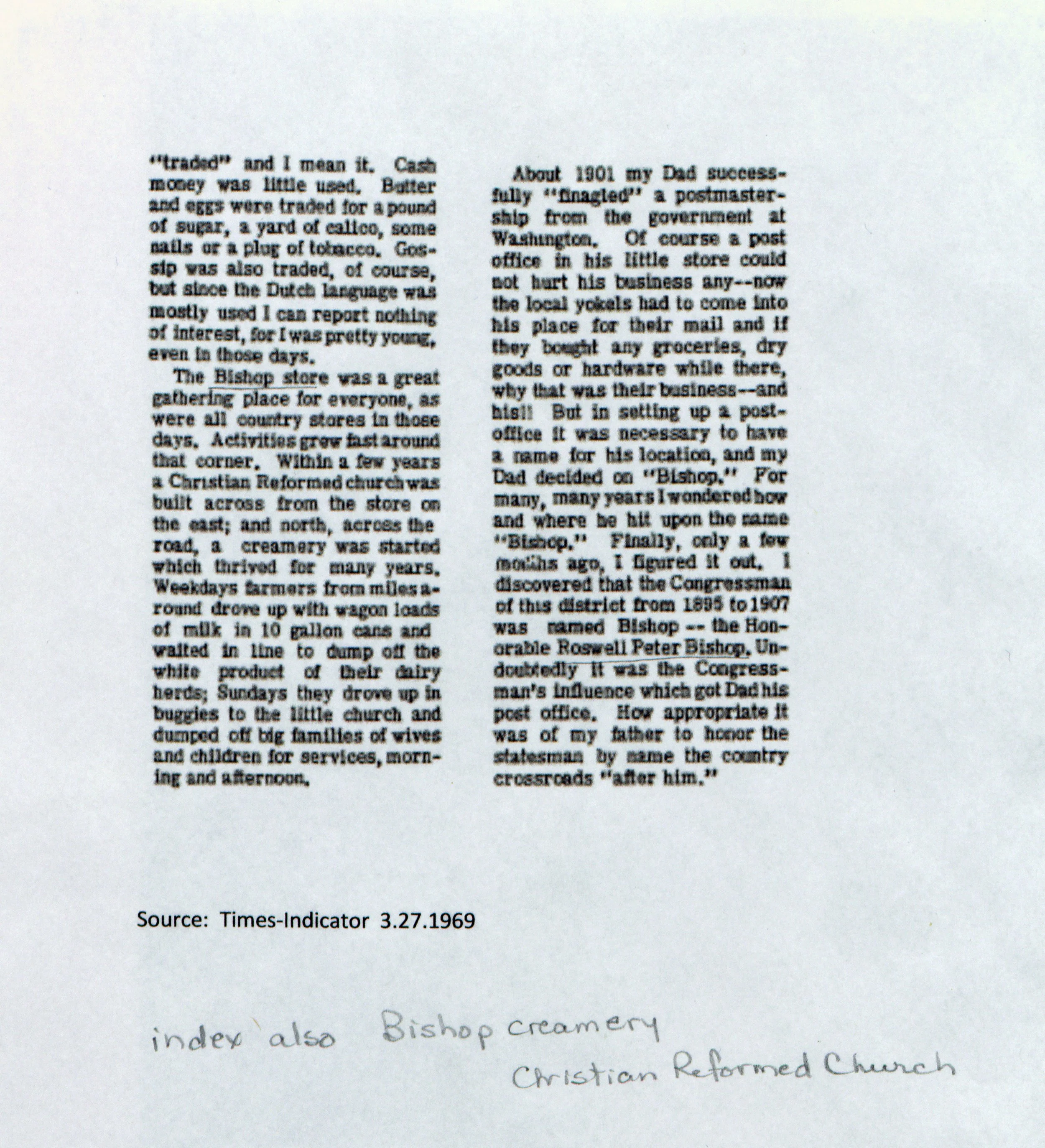
By Terry E. Waintz
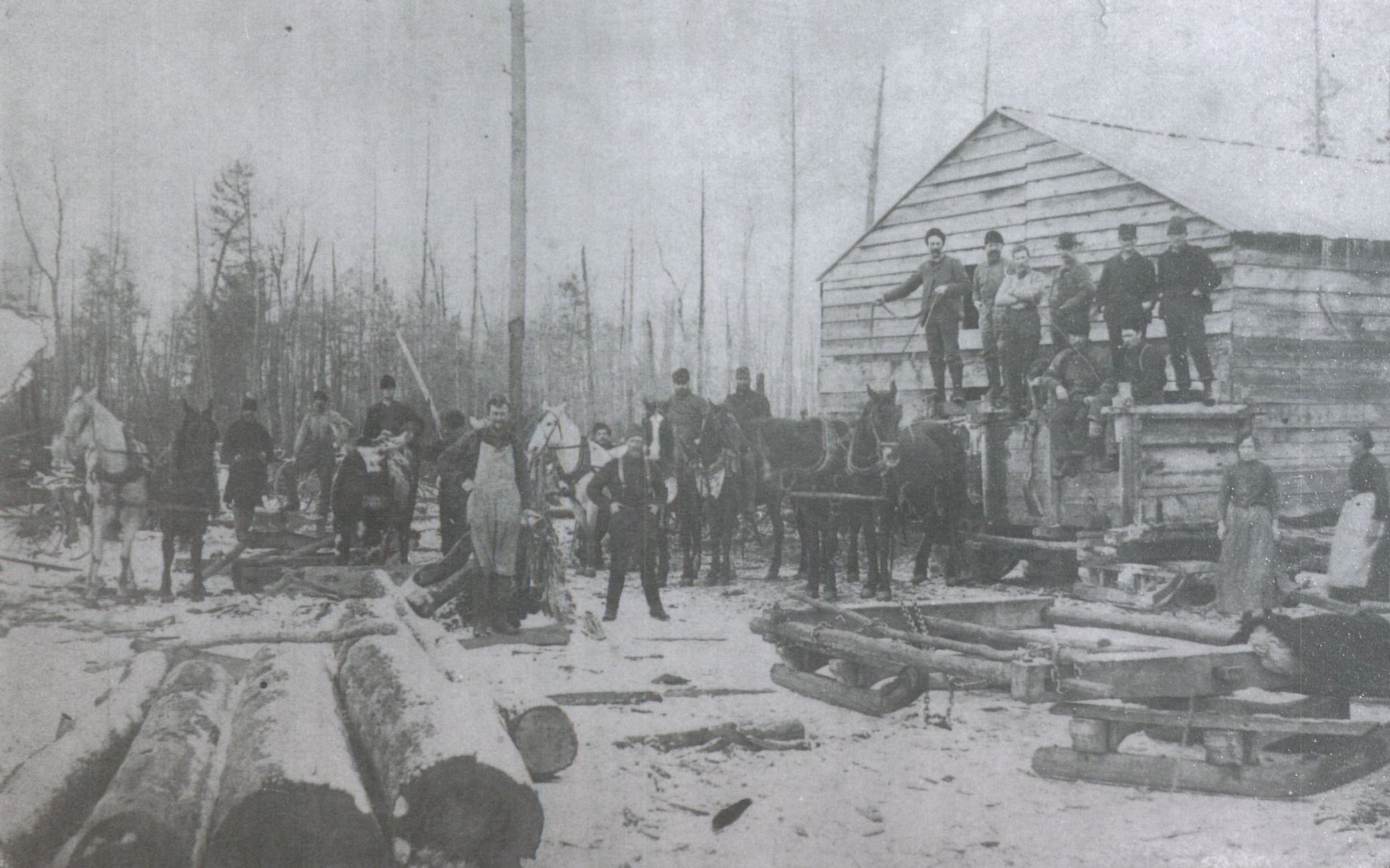
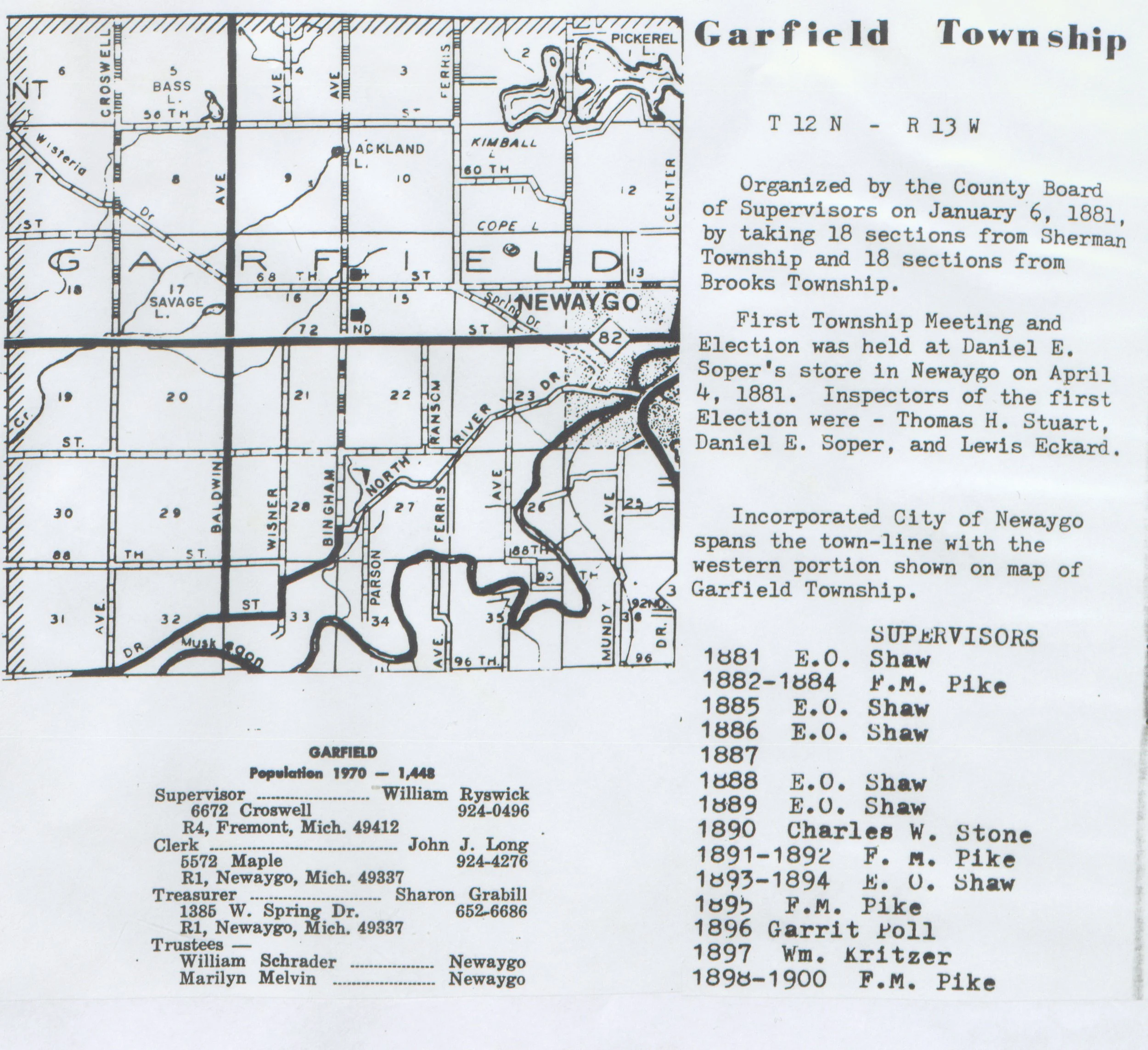
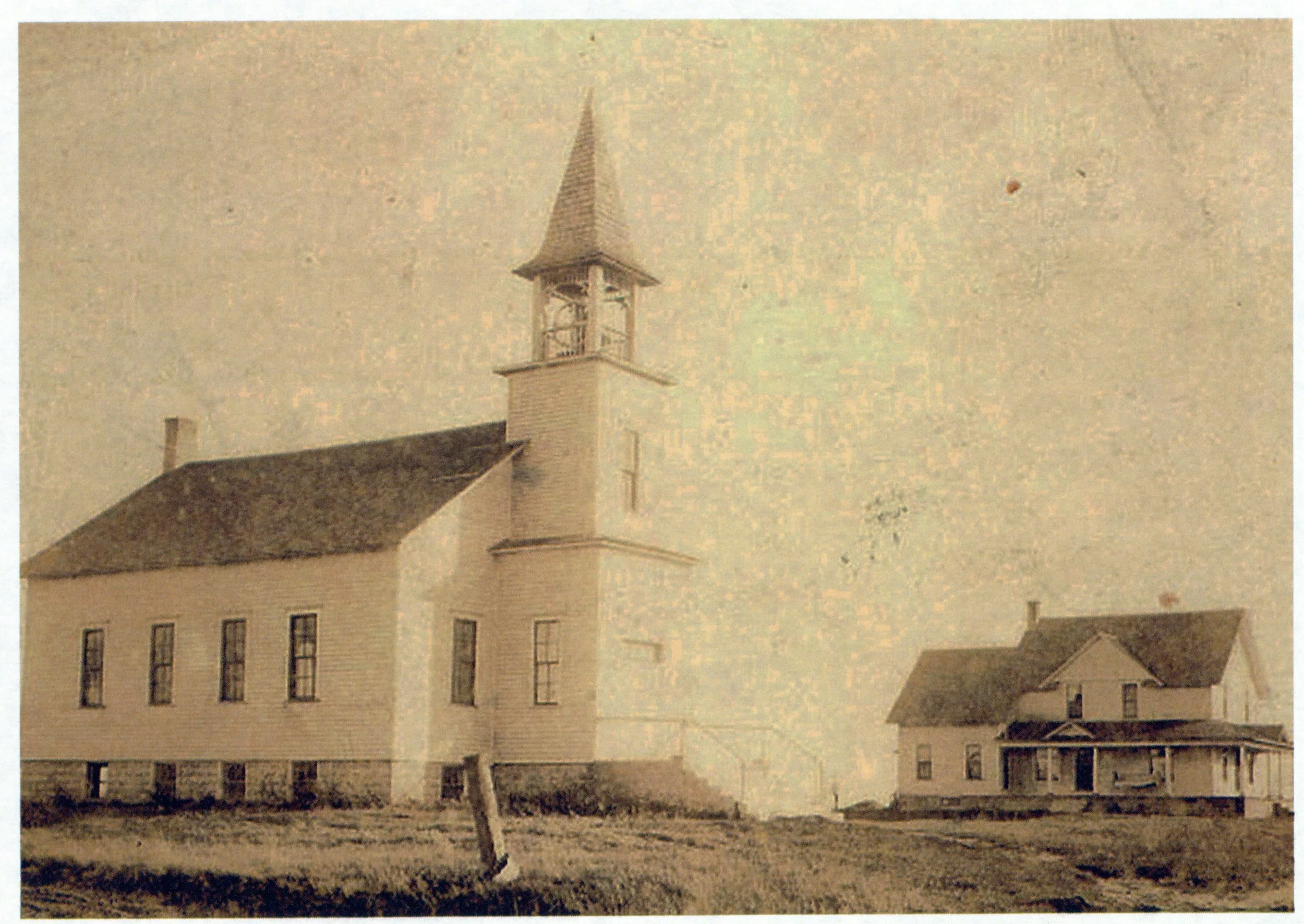
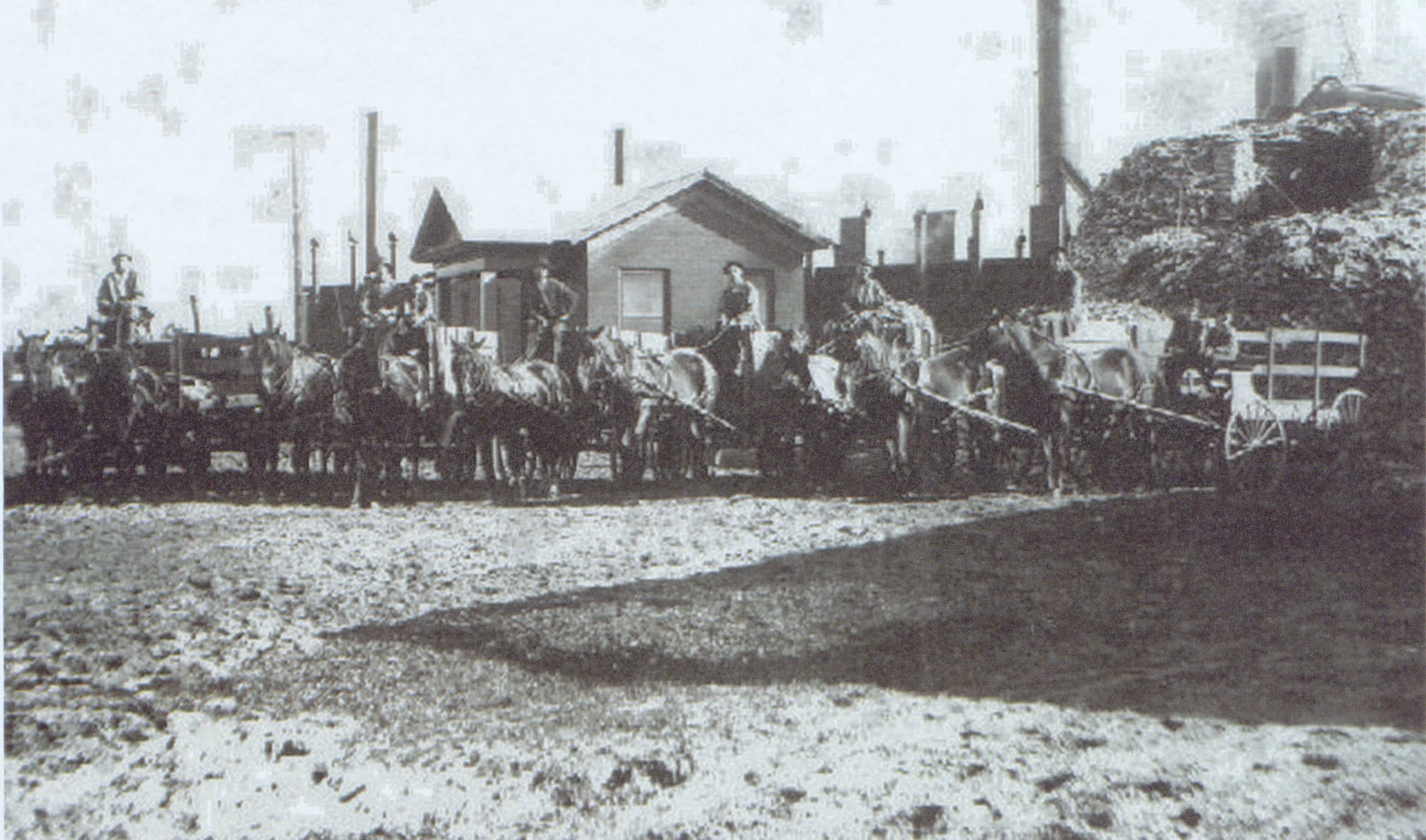
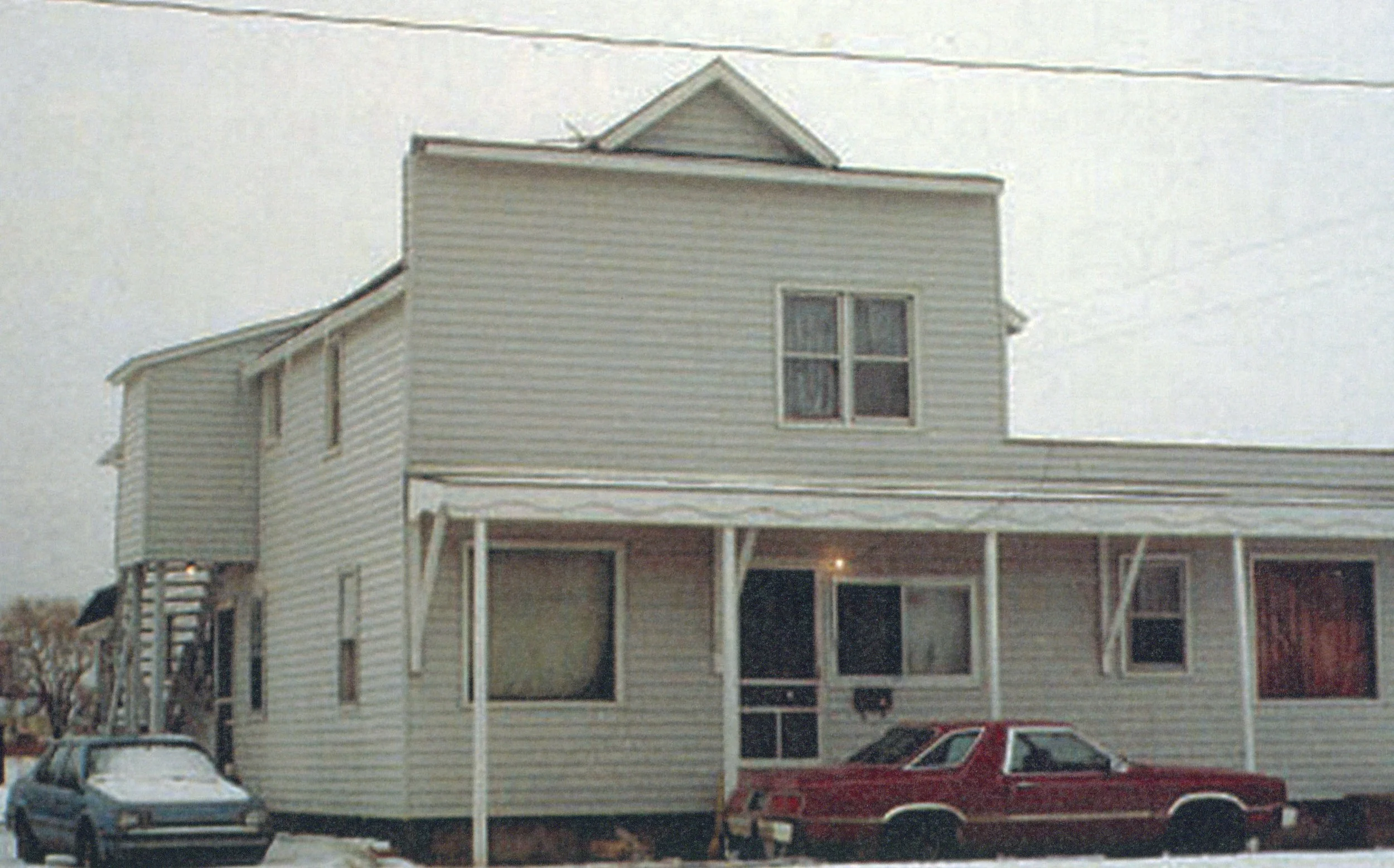
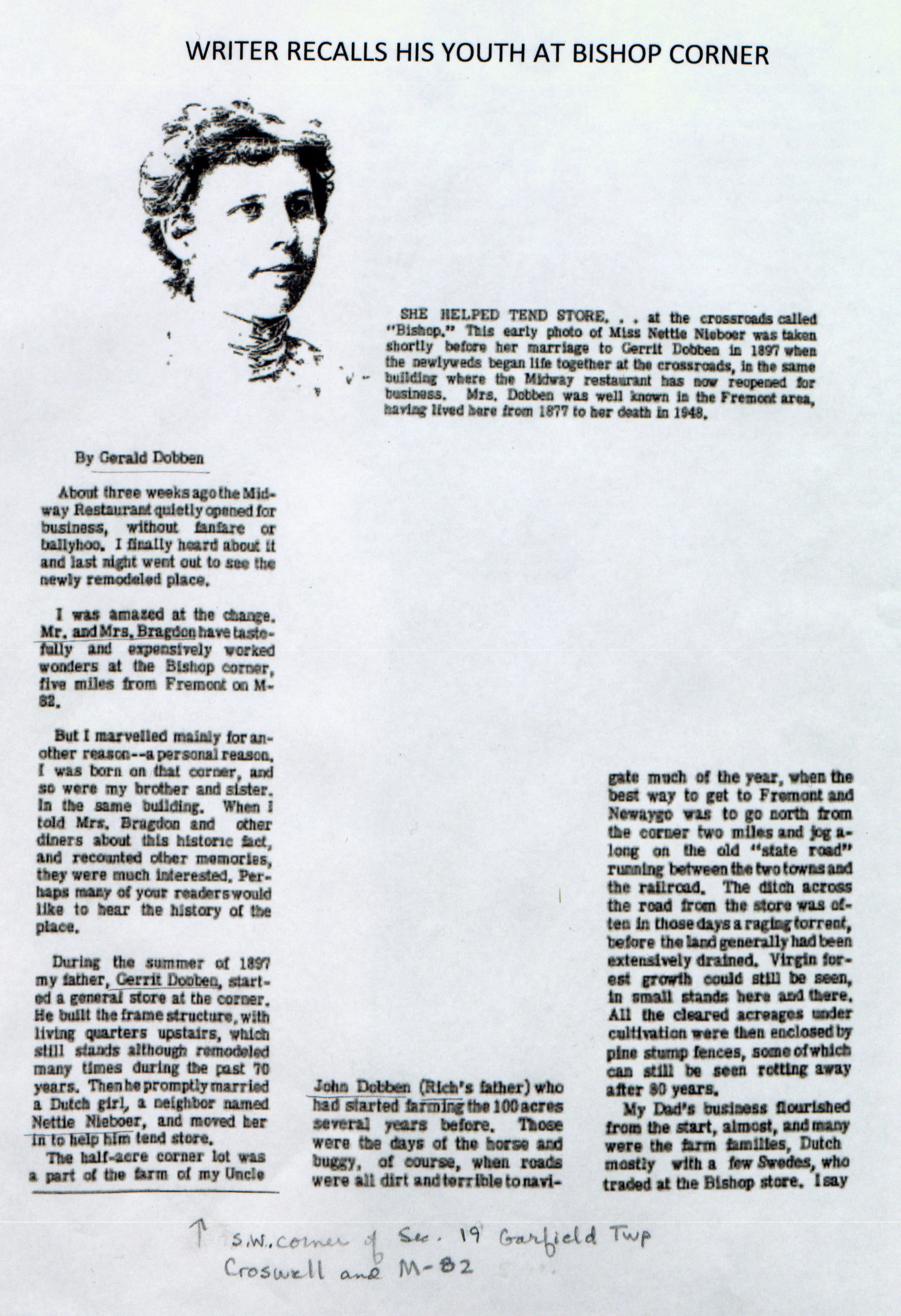
The Bishop Post Office was established in March 1898, three miles south and two miles of Fremont at the corner of Croswell Ave. and 72nd. St. The office was located in a store owned by Garrit Dobbin in Section 19 of Garfield Township. Garrit Dobbin was the only Postmaster, and the office closed on April 31, 1901 when Rural Free Delivery started. The Bishop Post Office was named after Col. R. P. Bishop of Ludington, who was for some time a Congressman from the district in which Newaygo County was located. There was a small settlement at this location, including a church, a garage, a creamery and the store. The church was the Christian Reformed Church and the Parsonage was built next door. They were located south of the corner of 72ad. St. on Croswell Ave. on the east side of the road. The Bishop Creamery Company was on the north side of 72ed St., across from the Dobbin's Store and the garage was also located on the north side of 72d. Street. In 1917, the phone number of the Bishop Creamery was 247-1L-1S-IL ( 247 was the line number and one long - one short - one long - ring, was for the Creamery.) At this time the Haverman Bros. owned the Bishop Store and their phone number was 247 - 1S - 2L or one short and two long rings. Most of these farm line would have from 10 to 20 customers and sometimes even more, per line. The other three line at Bishop were 249, 364 and 371.
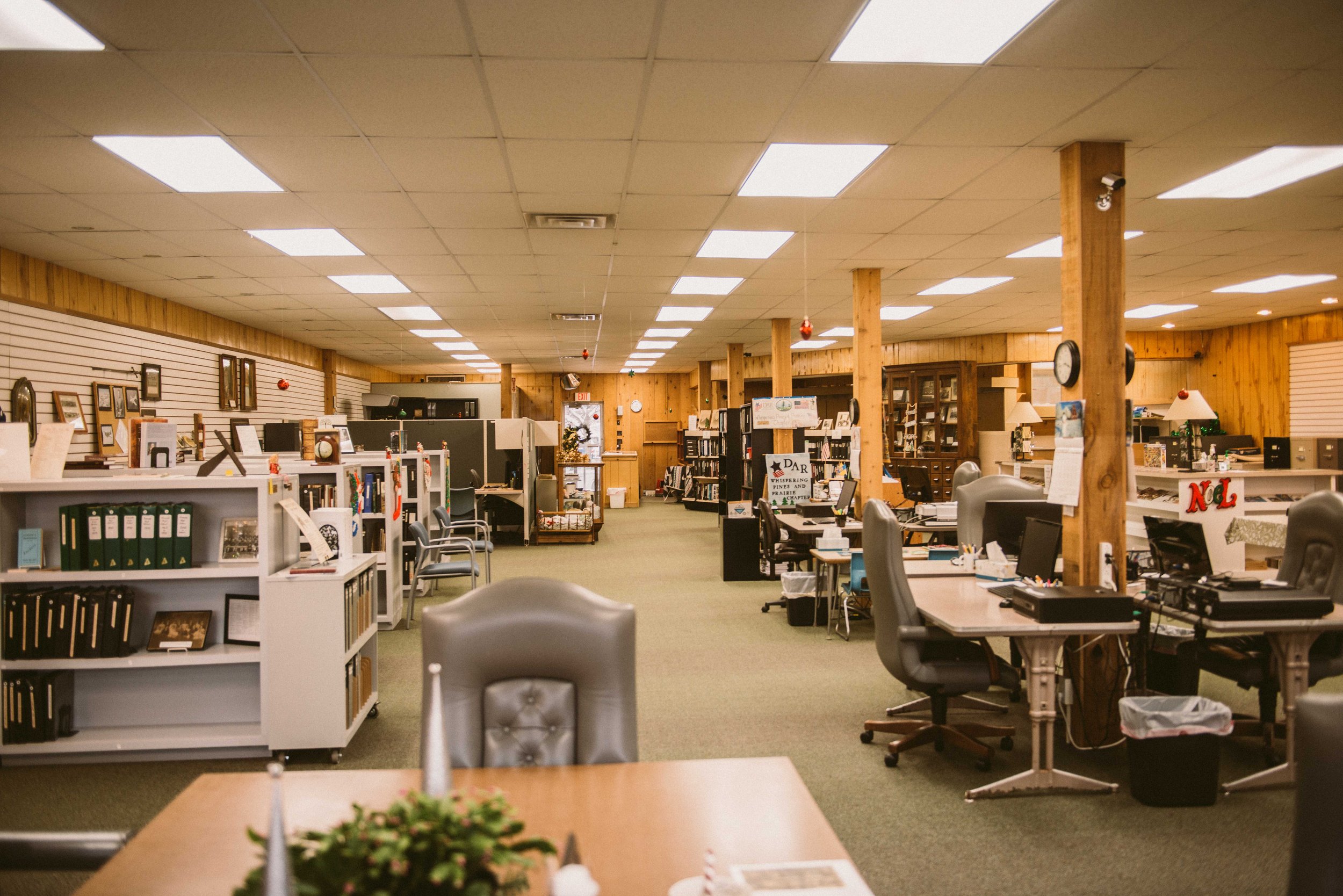
WE’VE MOVED
The Terry Wantz Historical Research Center has had the wonderful opportunity to move our operation across the street to the (former) Print Shop. Come check out our new location.
History Snapshot

Fremont's Golden Era of Athletics: 1895–1946
Featured Story

Surrerar Cemetery
Donate
Donate
Click here to send a donation directly to the Research Center

Local Events
Follow the link below for community events
We are a 501 (C) (3) nonprofit organization. We rely on funding from private sources, public sources and donations from people like you
— T.W. Historical Research Center
Explore
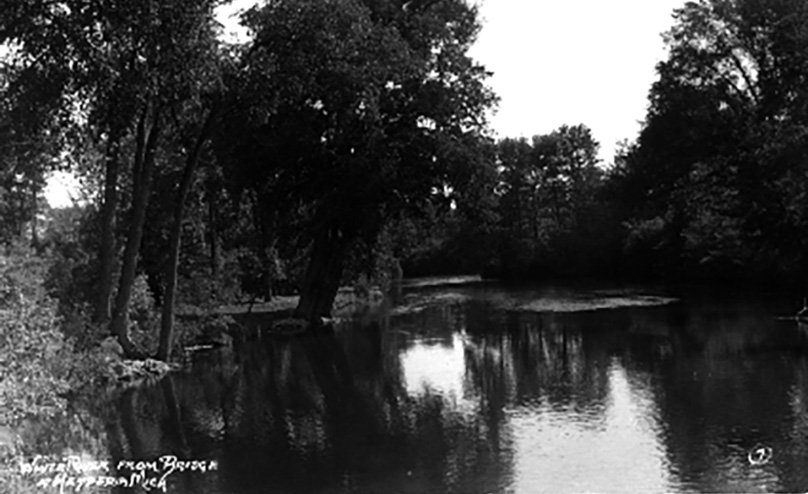
Hesperia
The Newaygo Republican
10 October 1870
“In the midst of a fertile region, on a rapid stream which furnishes abundant water power, the chief village on the White River above its mouth, the rendezvous for the lumberman of the extensive lumbering country around us, and the trading point for the whole country north of us as far as the Pere Marquette River, Hesperia is destined, we fondly imagine, to become a place of no inconsiderable importance,”
Nestled in between Newaygo and Oceana counties and along the White River is the village of Hesperia, Michigan. Daniel Weaver (1811-1879) established the village of Hesperia and Thaddeus Waters (1835-1923) both established successful lumbering mills within the village. The White River, which once played a key role in the lumbering boom of the 1800s, is still a vital part of the community as a source of recreational fun.
For more information about Hesperia, please visit the Terry Wantz Historical Research Center at 29 West Main Street Fremont, MI 49412, or call us at 1-(231)-335-2221. You can also visit our website at terrywantzresearchcenter.com.




We are grateful for the following foundations for their funding:

Floyd and Betty Lou Head

The TWHRC is supported by the Fremont Area Foundation,
Dogwood Foundation, Michigan Nonprofit Association, Terri Teall Memorial Fund, respective contributors, visiting authors, and our patrons and volunteers.
With Gratitude to the Dogwood Foundation
We are honored to receive continued generous support from the Dogwood Foundation for our 2025–2026 season. Their steadfast commitment helps make our work possible. Thank you for investing in creativity, community, and connection.
Thank you to the Fremont Area Community Foundation for their generous and continued support of the Terry Wantz Paper to Cloud Digitizing Project.
Thank you to the Floyd and Betty Lou Head Family Fund for their generous gift towards the Terry Wantz Paper to Cloud Project. We truly appreciate your investment in the Terry Wantz Historical Research Center and its continued success.